

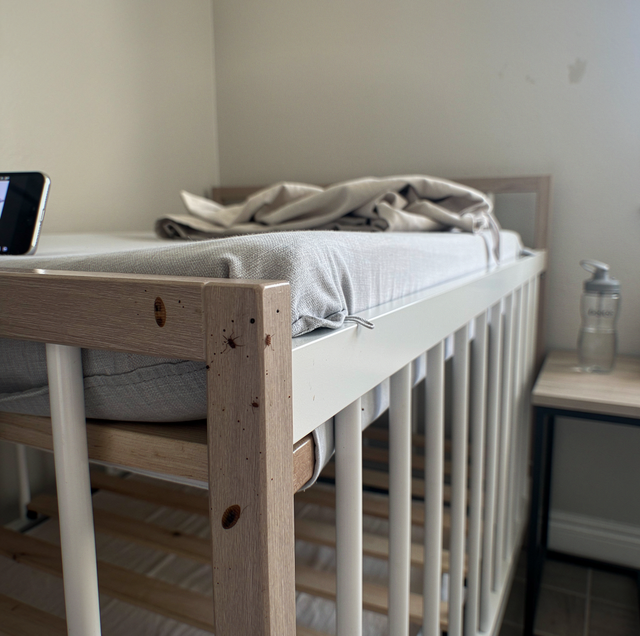
The slat is white, and the thing crossing it is small, flat, and brown. At the 2 a.m. diaper change, with the crib mattress lifted halfway out to tuck a fitted sheet corner back in, the phone light lands on the slat the mattress normally hides, and on a bug walking slowly along it toward the corner post. The pull in that moment is to do everything at once: strip the crib, spray it, drag it out of the room. The moves that help are fewer and quieter, and nearly all of them come down to leaving the crib exactly as it is until someone who treats bed bugs has looked at it.
Why a Crib Is No Different From Any Bed to a Bed Bug
Bed bugs live on the blood of sleeping people and spend the hours between meals packed into tight, dark spots close to where someone lies still. A bed's size and its age play no part. A crib holds a sleeper still through the night and again for naps, which gives a bug the same thing an adult bed does: a meal that stays put within crawling distance.
The crib also has the same kinds of places to rest. A bug can tuck into the seam and edge binding of the crib mattress, the narrow space where the mattress edge presses against the rails, the mattress support underneath, and the joints where each slat enters the top and bottom rails. None of those spots shows with the mattress down, which is why a first sighting can come at a moment like a sheet change, when the mattress is up.
The bug on the slat also got there from somewhere. It may have walked from another spot in the room, or arrived on a bag, a visitor's coat, or something carried into the home, the same routes that bring bed bugs into any house. That shapes everything that follows: a bug on the crib says the home needs a look, and the crib is one place in it. Bed bugs move through a home with the people who live there, from bed to couch and room to room, so the answer is never aimed at the crib alone.
The First Hour After the Find
Lower the mattress back into the crib the way it was and finish the change. Then work through a short list, much of it about what to leave undone.
Leave the crib where it stands: The crib, its mattress, the sheet and any blankets stay in the room. Carrying bedding down the hall to the washer, or rolling the crib out of the room, takes whatever is in the folds and seams along for the trip, and moving things is how one room's problem becomes two.
Spray nothing: No store spray, wipe-down, or powder on the crib, the mattress, or the floor around it. A product used there lands where a baby's hands and mouth go, and it can drive bugs deeper into the joints or out into the room, which leaves the inspection with less to read.
Hold the laundry: Crib bedding stays in the nursery until John has looked; what happens to it is part of the prep he sets after the inspection.
Get a picture if you can: A clear close-up of the bug, or of the slat where it was, can be texted ahead of the inspection. Note which slat and which end of the crib so that the spot can be found again.
Call early in the day: An early call gives the best chance of an inspection the same day.
Tell the rest of the household: Whoever handles the morning routine needs to know the crib stays as it is, so nobody strips it out of habit.
Where the Baby Sleeps Until the Inspection
Moving the baby feels like the obvious first step. The version that causes trouble is the one where the crib comes too. Wheeling the crib into another room, or carrying its mattress, sheet and blanket to a different bed, can move anything resting in those seams into a second room before anyone has looked at the first.
So the crib, its mattress and its bedding stay put. Where the baby spends the rest of the night, and the next naps, is a decision for the household, and the first call is the place to raise it. Say that a baby sleeps in that crib, describe where the crib stands in the home and what else is in the room, and John gives a plan that fits the home he is about to see.
Any mark on the baby's skin or any question about the baby's health belongs to the pediatrician. The home is a separate question, and the inspection answers it.
What the Inspection Looks at Around the Crib
A crib left exactly as it was found keeps every sign in place: the spotting along the mattress edge, the bug that went back into a joint, the slat where the first one was seen. A crib that has been wiped, sprayed, or taken apart hands over a thinner picture than the real one.
Bring these to the inspection:
- The exact spot and the night it happened
- When the crib and its mattress came into the home, and whether either was used before
- Any recent overnight guests or trips
- Any other place in the home where the bug or anything like it has turned up
Sometimes the bug turns out to be another insect, or nothing is found, and that answer comes as plainly. Either way, nothing goes in the trash before the inspection: a crib and its mattress are not written off on the strength of one bug on a slat.
How a Whole-Home Treatment Handles a Nursery
The nursery is one room in a whole-home job, treated along with every other room, the furniture, and the baseboards, because bugs that reach the crib can be elsewhere, too. A treatment aimed only at the crib, or only at the nursery, is not offered, since it would leave the rest of the home as it was.
The prep comes out of the inspection. Beds are stripped, and the laundry list is the one John gives. Medication, food, and toys are put away before he starts, along with anything else that is sensitive. A nursery holds items that sit somewhere between those categories, such as bottles, pacifiers, teethers and diaper creams, and the inspection is the time to ask which of them go away and where. How the crib, its mattress and its bedding fit into that list is also his to set, so ask about them by name.
On the day, everyone in the home, the baby and any pets included, stays out for the 4 hours the treatment needs to dry completely, and the household is back that night, with a second visit about two weeks later. Any questions about the baby and the treated rooms go to John at the inspection before the treatment is booked.
The hardest step on a night like that is the one that asks for the least. Left alone, the crib keeps its evidence where it can be read and keeps the problem in the rooms it has already reached, and a call made early the next day puts someone in the nursery who will see it exactly as it was found.
Frequently Asked Questions
It belongs on the list. A glider or rocker in a nursery holds an adult sitting still for long stretches at night, and its seat and back cushions are held on by ties or straps, with a gap where each cushion meets the frame. A matching ottoman adds its own cushion seams. Leave the chair where it stands and name it when you call.
Handle it the same way. A changing pad has contoured foam sides inside a cover with an elastic or zippered edge, and the shelves or baskets under the top hold folded cloths and spare sheets. Leave the pad, its cover, and the baskets as they are, and give John the exact spot.
If the baby naps in it, yes. A bassinet or play yard has a thin mattress pad, mesh sides joined to a fabric rim, and folding joints at the corners, and it sits wherever the baby sleeps during the day. It stays set up where it stands until John has seen it.
Yes. Teething guards wrap the top rails in padded fabric held on with ties or hook-and-loop tabs, and the underside of each guard, where it closes around the rail, is covered with a fold at the very top of the crib.
Some convertible cribs come with toddler guardrails or full-size bed rails that wait in a box or closet until they are needed. Parts that have been sealed in their packaging since the day they arrived have never been part of a bed. Parts that were used for an older child and then put away are worth mentioning. Leave either set where it is stored.
It widens it. With the crib beside an adult bed, the two make one sleeping area: a bug found on the crib may have come from the adult bed a few feet away, or the other way round, and signs on either one say something about the other. Say so on the call, so both beds are part of the same look.
Take the crib question to John on your first call — a free in-home inspection looks at the nursery with the rest of the home, and the plan for the crib comes before anything in it moves. Bed Bugs Arizona serves Phoenix and towns across Arizona. Call 623-451-0541.