

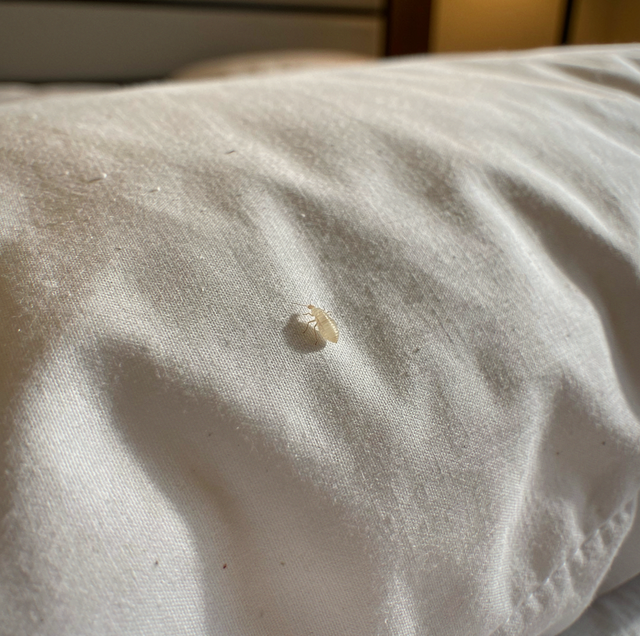
The speck on the white pillowcase is pale, nearly clear, and easy to miss until it moves; under the reading lamp, it shows six legs. "Baby bed bug" is the everyday term for exactly this: a young bed bug, one that has hatched from an egg and has not yet reached adult size. Finding only these, with no adult anywhere in sight, raises a fair question about what is going on in the bed.
What Young Bed Bugs Look Like
Young bed bugs are smaller than adults and translucent or whitish-yellow. One that has not fed recently can be close to invisible to the naked eye, especially against a pale sheet or a light fabric seam. The skins young bugs shed as they grow are pale yellow too, and eggs are pale as well, so the whole set of early signs blends into light bedding.
Adults are the bugs people picture, brown and easy to pick out on a sheet. A young one gives the eye very little to catch, and anything this small and pale is mistaken for lint, a loose fiber, or a crumb. Movement helps a little, since lint and crumbs stay put while a young bug walks, and a disturbed one can head for the nearest seam or fold. Telling them apart still takes someone who knows the bugs.
Why Young Ones Can Be the First Thing Anyone Sees
Only adult females lay eggs, and every bed bug starts out as a young one when it hatches. So a young bug on the sheets is evidence that eggs were laid somewhere close enough for it to hatch and walk to where a person sleeps.
Timing adds a second reason. Eggs hatch within about two weeks, a little sooner in a warm room and later in a cool one. Eggs laid close together can hatch close together, so several young bugs can appear within a short stretch. The bugs may have been present well before the first one was seen. Because room temperature moves the hatch date either way, the date of a first sighting tells little.
Each adult female lays many eggs over her life, so in a breeding group, young bugs can outnumber adults, and the odds favor a young one being the bug that crosses the sheet. Every stage has to come out to feed, which brings bugs across the open fabric where a sleeper's sheets are, so which stage shows up on a given morning depends on which one crossed the open fabric and which one a person happened to notice. A small, pale bug is easy to miss, so spotting one may occur before anyone has seen an adult.
Reading a Sighting of Young Bugs Alone
Young bugs alone tend to indicate that bed bugs are breeding nearby, with adults tucked into places out of view. That reading rests on one fact: young bugs come from eggs, and eggs come from adults. A find of only young ones is better read as adults not yet seen than as adults absent. It is a likelihood, not a finding, and only a look at the sleeping areas confirms it.
The sighting leaves several things open:
- How many: The bugs out in the open are the ones that happened to be seen, and any others are out of sight.
- How long: A young bug carries no date, and hatching speed shifts with room temperature.
- Where the center is: The spot where a bug was found is where it wandered, which can differ from where it rests.
- Whether it is a bed bug at all: A small pale speck gets misread, and a clear close-up can be texted for a first opinion.
A sighting like this is a reason to call early. It is no verdict in either direction, and waiting for an adult to turn up gains nothing.
Other Signs Worth a Look From Where You Stand
Bed bugs leave a trail beyond the bugs themselves: dark spotting, eggs and pale shed skins, gathered in the same seams where young bugs turn up.
Look only at what shows without moving anything. Bites alone cannot settle whether bed bugs are present, and a strong skin reaction is a matter for a health care provider. A dark spot, a shed skin, or an egg beside a young bug adds weight to the sighting, and finding none of them does not rule out bed bugs.
The Inspection Settles the Rest
The free in-home inspection is done by John, who looks over the bed, the furniture, and the surrounding rooms, and the result is one of three: bed bugs, another pest, or nothing found. Until he arrives, the best thing to do is to leave everything where it stands. No stripping the bed, no flipping the mattress, no carrying things out of the room, no bug bombs. The inspection reads the home as the bugs left it, and that reading decides how Pro-Treat Plus, the whole-home treatment applied by hand, gets planned.
If the speck is still on the pillowcase, leave it there and mention it when you call; if it is gone, say so. What you saw and where you saw it is enough to start the conversation.
Small bugs leave small evidence, and the sensible response to small evidence is to leave it in place and let someone who knows these bugs read it.
Frequently Asked Questions
No. Every insect has six legs, so the count proves nothing. A young bed bug is flat and oval seen from above, and a speck with a different outline is still worth describing to John.
It can. A hand lens held over the speck where it lies shows the legs and the flat body shape more plainly than the eye alone, without needing to touch it. Lifting the speck to look closer moves it off the spot the inspection reads.
Yes. Nymph is the name for any young bed bug between hatching and adulthood. Bed bugs have no grub-like larval stage, so each young bug is a smaller, paler version of the adult, and once seen up close, it is recognizable as a bed bug.
Counting adds little, and hunting for more to count means lifting sheets and pulling at seams; the inspection needs to be left as they are. What helps instead is what you saw and which piece of furniture it was on.
Leave them on. The sheets already on the bed hold whatever has landed on them since they were last changed, and fresh ones would start that record over before anyone has read it.
Not necessarily. A bug found on the case can have crawled up from the mattress seams or the headboard behind it on its way to a sleeper. Leave the pillow on the bed with its case still on for the inspection.
Read John a description of those pale specks — a free in-home inspection settles whether they are bed bugs before anything gets moved. Bed Bugs Arizona serves Phoenix and towns across Arizona. Call 623-451-0541.