

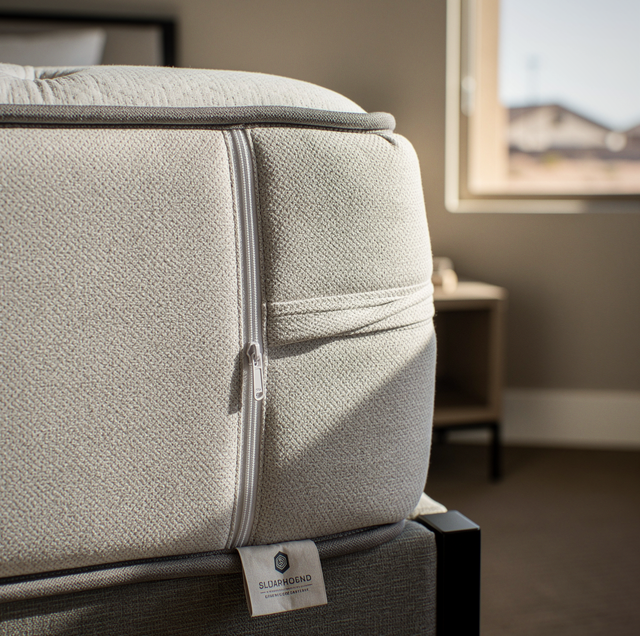
The zipper tape on the knit cover runs the full length of the mattress, and a fingertip traces it slowly along the side of the bed while a lamp lights the stitching, the cover still zipped shut. A solid foam mattress has no coils and no hollow spaces, so it is fair to ask whether bed bugs can live in one at all. They do not live inside the foam. They settle on the parts of the bed that give them a gap to press into, and a foam mattress has those parts too.
Why Dense Foam Gives Bed Bugs Nothing to Hold
Bed bugs are flat, wingless, and built to rest in a crack that touches them on both sides. They do not dig. A bug that wants to hide has to find an existing gap, and dense foam is a continuous solid with no opening for a resting bug to wedge into.
That does not keep one off the surface. A bug can walk across the top of a mattress on its way to a sleeper and back, and a stray one can be found there. Walking across foam and living in it are separate things, and the first leaves nothing hidden in the foam. Mattresses that layer other materials with the foam can add folds that a plain block lacks, so the construction of a particular bed gets read during the inspection.
The sleeper matters more to a bug than the mattress does. Bed bugs feed on people while they sleep and then retreat to cover, so the useful question about any bed is how close each fold sits to where a body lies. A thick foam block gives a bug no shelter near the sleeper, and the fabric edges around it supply the shelter instead.
The Cover, the Seams and the Base
Bed bugs settle where fabric is folded or stitched: along the piping at the mattress edge, in the seam lines and under the tags. On a bed with a zipper, the strip along it is another place to check. A bug pressed into any of these is touching material on both sides, the same arrangement it rests in anywhere else.
The box spring or foundation sits under the mattress and carries fabric seams and edges of its own. John regularly finds bed bugs in box springs, and the headboard and frame beside the bed sit a short walk from the edge of the mattress, so bugs move among all of them. Foam and innerspring beds share the same outer folds, so the areas where bugs rest are the same on both.
What a Boxed Mattress and Its Base Add
A foam mattress shipped compressed in plastic arrives with nothing on it. Unrolled in a bedroom, it has the same seams, tags, and edges as any other mattress, because those folds are part of how it is built.
The base that comes with it adds seams and joints of its own, and the inspection reads them along with the mattress. Bed bugs hitch rides on clothes and belongings, so a boxed mattress can encounter them as readily as an old one. What matters is what travels into the room, not the age of the bed.
The same goes for the plastic wrap and the cardboard it shipped in. Once the bed is set up, those are gone, and the room's own belongings are what is left to carry anything in, which keeps attention on bags, clothes, and furniture moving in and out of the bedroom.
Reading the Folds for Signs
Bugs leave their evidence where they rest, so the folds are where to look. Go along the piping and seam lines, around the tags and next to the zipper if there is one. The signs are live bugs, dark specks about the size of a pen dot (dried droppings), rusty smears, and pale shed skins.
Leave the mattress where it is. Carrying it or anything else to another room before the inspection can spread the problem, because bed bugs move with the belongings of the people who live in a home. A mattress that looks clean on the sleeping surface can still have a find along an edge, which is why the folds get the attention and the flat top does not. If something turns up, a clear close-up photo can be texted to John.
Leave the bed made as is for now, and note where on the mattress each sign appeared, so the inspection can start at those spots.
Whether the Mattress Stays
The bed and every other piece of furniture are treated as part of the whole-home job, along with the baseboards in each room. Usually a mattress does not have to be thrown out. Whether a particular one needs anything more is settled at the free inspection, which stays free whichever way it turns out, and a same-day inspection is possible when the call comes in early. Wait for that before anything is thrown away.
During the inspection, John makes a plan for the home based on the severity of the problem and the home's condition, and he walks through it before anything is decided.
Foam takes nothing away from the folds a bed bug uses, and it adds none of its own. The seams, tags, and base are where the evidence sits, and one inspection reads them all.
Frequently Asked Questions
It can add folds. Stitched quilting lines and the edge where the top layer joins the side panel are extra seams to look along. A bug resting in one of them is touching fabric on both sides, so they get the same attention as the piping.
Yes. The thin fabric across the bottom is attached along its edges, and a gap can form there, with more joints in the frame inside. Tipping the box spring to look is awkward, which is one reason to leave it for the inspection.
Some foam mattresses are built with their layers in a set order and are not meant to be flipped, and the paperwork that came with the bed says which. Turning a heavy mattress also shifts the bed's entire setup. John goes over what to touch and what to leave when he inspects.
It does. Two mattresses set side by side on one base meet in a long line down the middle of the bed, right under the people sleeping there, and each half has its own piping and seams along that inner edge. Look into that center line as closely as the outer edges.
It can. Bugs can settle in the folds closest to where a person lies, so the seams on the sleeper's side or along the head end can show activity while the other side looks clean. Both sides still get looked at.
Some foam mattresses have carry handles stitched to the side panel or small vent openings. The stitching around them forms a fold small enough to miss, and the inspection includes them.
Point John to the seam or spot that worried you — a free inspection shows whether the bed has bed bugs and what the whole-home treatment needs to cover. Bed Bugs Arizona serves Phoenix and towns across Arizona. Call 623-451-0541.