

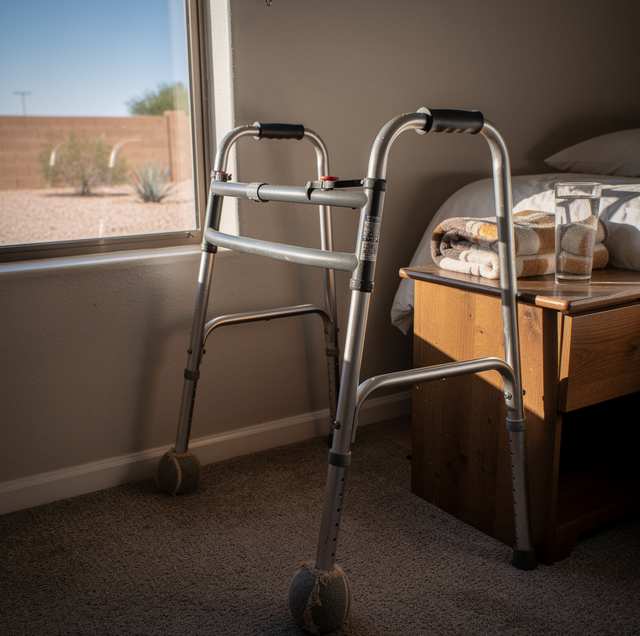
Two tennis balls, worn gray where they meet the floor, cap the back legs of a folded walker leaning against the bedside table for the night. The walker stands within arm's reach of the pillow. By breakfast it will be rolling toward the dining room, then the lounge, then perhaps out to an appointment, and by evening it will be back in the same spot beside the bed. Can bed bugs live in a wheelchair or walker? They can rest on one, in the padded and fabric parts, and a mobility aid spends its nights beside a sleeping person and its days beside the same person everywhere else. The bare frame gives a bug very little. The softer parts fixed to it are where a look pays off.
How a Walker or Wheelchair Is Put Together
Bed bugs feed on a sleeping or resting person and then crawl back into a narrow, dark gap nearby to wait for the next meal. They grip rough and fabric surfaces with ease and find little footing on smooth, polished metal or hard plastic. That habit sets which parts of a mobility aid matter.
A standard walker is two side frames of lightweight tubing joined by a crossbar, with a grip on each handle and feet or glides at the bottom. The side frames fold toward each other so the walker can stand flat against a wall. A rollator, the wheeled kind with brakes, adds a padded seat across the middle, a padded strap or bar behind it as a backrest, and hand brakes with cables running down the frame to the rear wheels.
A manual wheelchair is a frame on two large wheels and two small front casters. The seat and back are lengths of upholstery fabric or vinyl stretched between the side rails (called slings), and a separate cushion sits on the seat sling in its own cover. Padded armrests, side guards that keep clothing off the wheels, footrests or leg rests, and push handles make up the rest. A folding chair collapses sideways on an X-shaped brace under the seat, which pulls the slings into soft pleats when the chair is folded.
Across all of these, the parts worth attention share one trait: fabric, padding, a seam or a place where two pieces overlap, sitting close to the person.
The Padded and Fabric Parts
The seat and back slings: Each sling is hemmed where it wraps around a side rail, and that hem is a doubled band of fabric running the full length of the seat or back. On vinyl slings, the stitching along the edges leaves a line of small holes and a raised seam.
The seat cushion: Foam inside a fabric cover brings seams, edge piping, and corners. The crease where the cushion meets the sling, and the narrow strip where it presses against the armrest side, stay shaded all day.
Armrest pads and handgrips: A padded armrest top is fixed to a hard base, and the line where the two meet forms a narrow seam. Foam or rubber grips on a walker fit tight on the tubing, leaving little room, though a split or a worn end can open a gap.
The rollator seat and backrest: The padded seat has a stitched edge all the way around, and its underside faces the floor. The backrest strap is fabric over padding, with seams at each end where it fastens to the frame.
Bags and pouches hung on the aid: A bag on the back of a wheelchair, a pouch on an armrest or a tray bag hung on a walker brings pockets, flaps and inner seams, plus whatever lives in them: a folded cardigan, a few letters, a spare pair of socks.
The side guards, the folding brace, the wheels and the frame tubing give a bug almost nothing to hold on to, except where fabric, a gap or a fastener meets them. The signs on any of these parts are the signs bed bugs leave anywhere: live bugs, small dark spots of droppings, pale shed skins and tiny eggs, lined up along a seam or hem.
What the Person Who Uses It Is Placed to See
The person who relies on the aid has the closest daily contact with it and the worst angle on it. Seated in a wheelchair, someone sees the armrest pads and the front edge of the cushion, while the back sling's outer face, the underside of the seat, and the hems along the rails all face away. Gripping a walker or rollator, someone looks down on the handles and the top of the seat, and sees nothing underneath.
The hidden faces come into view for whoever pushes the chair, folds it for a car trunk or sets the walker beside the bed at night: a family member, a caregiver, a staff member. Those are the people best placed to notice a dark spot along a hem or pale skin in the crease of the cushion, looking in good light without taking anything off.
What they see can mislead. Grease from the folding parts, rubber dust from the wheels, and dried spills from a meal tray all leave dark marks on fabric that sits low and gets handled every day. Only a trained eye can tell bed bug spotting from ordinary wear. Marks on the skin are no better as a guide, since a bite cannot show what caused it.
Finding a sign on a wheelchair or walker says nothing about how well the person, the family, or the staff look after it. Bed bugs travel on people and their belongings, and an aid that goes everywhere picks up whatever is in the places it goes.
Between the First Sign and the Inspection
Staff or family who spot a sign on the aid leave it where it stands, take a clear close-up photo if they can, and call early in the day. Leave the seams, pads and pouches as they are, with nothing applied to them, so the inspection finds the signs where they formed.
Whether the person keeps using the aid until John arrives is a question to raise on the call and with their health care provider, who provides the aid every day.
What helps most on that call is a picture of the aid's day. List where it went in the last few weeks: the dining room, a day program, a relative's home, a waiting room. Mention where it stands at night, and whether anything is stored in its bag. That route is where a bug riding on the aid could have come from, and where it could have stepped off.
In a care home, the facility initiates this. John inspects the rooms staff are worried about and tells the facility what he found and how serious it is, so staff can name the aid along with the bed when John comes to inspect.
How the Aid Fits a Whole-Home Job
At the inspection, a wheelchair or walker is a place to look, along with the bed, the chair by the television, and anything else the person rests on.
If bed bugs are confirmed, treatment covers the whole home, or the rooms the facility and John agree on, with a second visit about two weeks later. What happens with the wheelchair or walker on those days is something John tells the facility or the family when he walks through the plan and the prep. Follow what he says for that aid.
The whole home matters for a mobility aid in particular because the aid goes wherever the person goes. A bug that rode from the bedroom to the lounge on a seat cushion is now in the lounge, and a plan that stopped at the bedroom door would leave it there. The aid's daily route, the one listed on the call, shows how far the look has to reach.
Bare tubing and rubber feet give a bed bug almost nothing. The fabric fixed to them is a different matter, and it travels from the bedside to every room the person visits and back again each night. Leave the aid as it is, say where it has been, and let the inspection read what it carries.
Frequently Asked Questions
They can. Each ball is cut with a slit to push it onto the leg, and that slit closes around the tube into a narrow, dark pocket at floor level beside the bed. The felt cover also holds dust and specks. Leave the balls on and mention them at the inspection.
A hole wide enough for the button is wide enough for a bed bug. The row of small holes along each leg lets a spring-loaded button lock the height, and the hollow tube behind it is dark. Whether anything is inside is for the inspection to judge.
It depends on what it is made of. An open wire or plastic mesh basket offers almost no cover on its own, while a fabric liner or a zip-top storage pouch under the seat has seams and a closing flap. Whatever sits inside it counts as much as the basket itself.
Both add a layer. A sheepskin pad's deep fleece and its leather or fabric backing give a bug cover close to the person, and a gel pad sits in a cover with its own sewn edges. Leave the pad where it lies on the seat and name it on the call.
Yes. Calf straps, seat belts, and positioning straps are lengths of webbing sewn back on themselves into loops, and some fasten with hook-and-loop tape whose hook side snags fibers and debris. Each sewn loop is a doubled seam.
Less. A cane is a single shaft with a rubber tip, and the only cover it offers is a foam or wrapped grip. Crutches add a padded underarm cushion and a padded hand grip, each a cover over foam.
Look into a free inspection — have John check the wheelchair or walker and the rooms it travels through before anyone decides what it needs. Bed Bugs Arizona serves Phoenix and towns across Arizona. Call 623-451-0541.