

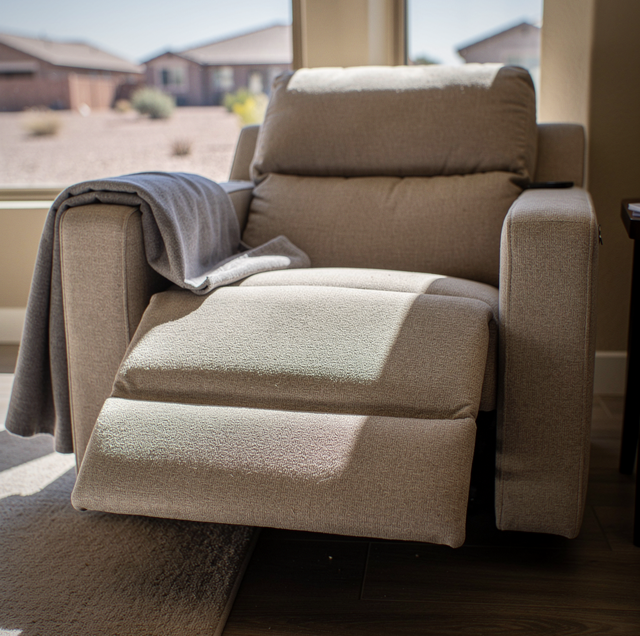
The low hum stops, and the footrest of the lift chair folds back under the seat after a long afternoon nap in front of the television. Riding down with it, on the fabric where the footrest pad meets the front of the seat, is a dark speck. It sits in plain view for a second, then the fabric doubles over, and it is gone. Can bed bugs live in a power recliner or lift chair? They can, just as they can live in any upholstered seat someone spends long, still hours in. What a powered chair adds is fabric that moves: folds that open when the back tilts and the footrest comes out, and close again when the chair returns upright. Those folds change where a bug can tuck in, how easily anyone sees it, and what should be left alone until the chair has been looked at.
Under the Upholstery of a Power Recliner
A power recliner is a wooden or metal frame wrapped in padding, with a mechanism under the seat that extends the footrest and tilts the back. A small motor drives that mechanism. On a lift chair, the same mechanism raises the whole seat and tilts it forward. The upholstery is cut and sewn to cover all of that while still letting it move, so it carries more loose fabric than a fixed chair does: slack panels that take up the stretch when the chair reclines, a fabric flap joining the footrest pad to the seat front, and on some chairs a skirt that hangs around the base.
Underneath, some upholstered chairs close off the bottom with a dust cover, a thin sheet of lightweight fabric stapled across the base to hide the frame and keep debris from falling through. On a power chair, that cover and the lower edge of the skirt sit at floor level in shade, where nobody looks during daily use.
A chair someone dozes in through the afternoon is a resting place bed bugs can use like any other seat. The open question about a powered chair is whether its extra fabric gives them more places to wait; on some chairs, it can.
The Folds That Open and Close With the Motor
When the back reclines, the fabric between the seat and the backrest pulls taut, and when the chair comes upright it slackens and bunches again. When the footrest swings out, the flap connecting it to the seat front opens to reveal a strip of exposed fabric, then doubles over as the footrest tucks away. On a lift chair, the rise and forward tilt open a band of fabric along the base that stays closed whenever the chair is down.
Each of those folds sits closed, dark and pressed together whenever the chair is at rest, and it opens only while someone is settling into the chair or getting out of it. That pairing is what makes a moving chair harder to read than a fixed one. The speck on the footrest flap was visible only when the fabric was stretched flat. Once the footrest dropped, it sat inside a fold that a flashlight held from the outside may not reach.
None of that tells anyone where bugs are inside a particular chair. Chairs differ in how their covers are cut and how much spare fabric they carry, and some leave very little slack at all. Only a trained eye can tell whether anything is living in that chair.
What Shows Up on a Chair Used Every Day
The signs on a powered chair are the same as those bed bugs leave anywhere: live bugs, small dark spots of droppings, pale shed skins, and tiny white eggs. What differs is where anyone who uses the chair is in a position to see them. The places worth noticing are the ones the motion brings into view: the footrest flap when the footrest is out, the fabric between the seat and back when the chair is reclined, and the lower edge of the skirt at floor level.
A blanket or throw that lives on the chair can pick up small rusty stains if a bug was crushed against it during a nap. Marks on the skin after an afternoon in the chair are a poor guide, since a bite cannot show what caused it, and any reaction is for a health care provider to look at.
A flashlight on the seams that are already visible is as far as a homeowner's check needs to go. If something turns up, a clear close-up photo can be texted to John before the inspection.
Hands Off the Mechanism Before the Inspection
On a powered chair, the pull is to run it: send the footrest out and back, tip the seat forward, recline it flat, all to see into the folds. Each run opens and presses shut the same fabric along with whatever is resting in it, and tipping the chair over or pulling the dust cover loose would disturb even more of it.
Leave the chair where it stands, in whatever position it is in, with the dust cover, the skirt and the throw left as they are, whether to keep sitting in it until the inspection is a fair question to put to John on the call.
Keep hands, tools and small children away from the space under a raised footrest or lifted seat. A powered frame can close with real force, so leave the chair at rest for John to look over at the inspection.
How the Chair Fits Into a Whole-Home Treatment
The free inspection runs through the places people spend their time: beds first, then couches, recliners and other chairs. A power recliner or lift chair is on that list whether or not the first find was there. John decides at the inspection what the chair needs, and the plan he walks through before anything is agreed covers it along with everything else in the home.
If bed bugs are confirmed, the treatment covers the whole home. John works through every room with a hand sprayer and a hand duster, treating beds, couches, recliners, and every other piece of furniture, along with the baseboards. The chair is treated in place as one piece of furniture among the rest, never as a job by itself.
The whole home matters for a chair in particular because the person in it gets up. Bed bugs travel on clothes and belongings and move with people from the chair to the bed and back, so a treatment that stopped at the living room would leave every other room the person uses untreated.
Wait for the inspection before deciding the chair has to go.
Every feature that makes a power recliner comfortable- the footrest that swings out, the back that lies nearly flat, the seat that rises- adds fabric that folds out of sight. Those folds call for patience. Leave them closed, mention the chair on the call, and let the inspection settle what, if anything, is living in the chair before a single staple comes out.
Frequently Asked Questions
Only in what moves it. A manual recliner opens with a release handle or lever on the side, and a push-back style opens when the person sitting leans against the backrest. The footrest flap and the fabric between the seat and back fold the same way they do on a powered chair, so a manual recliner goes on the same list during inspection and is handled the same way.
It counts as one piece of furniture with several reclining seats. Some reclining sofas and sectionals add a center console between two seats, with cup holders and a storage bin under a lift-up lid, which brings another set of closed, shaded corners into the middle of the seating. Leave whatever is stored in the console where it is and mention it on the call.
It adds fabric. A caddy that drapes over the arm is held in place by a flap tucked under the seat cushion, and it has its own seams and pockets full of remotes, glasses, and papers, all within arm's reach of someone who naps in the chair. Leave it hanging, with its contents in place, so it can be viewed as is.
Leave them on. A stretch slipcover is held in place by tuck-in strips pushed down into the creases around the seat, and pulling it off drags those strips, along with anything resting on them, out across the room. Arm covers stay put for the same reason. What sits under them is for the inspection to judge.
It might, and it might not. Used furniture is one way bed bugs come into a home, along with travel, overnight guests, a neighboring unit, and a move. A chair that arrived a few weeks before the first sign fits the timing, but timing alone cannot rule out another route, and the inspection covers the whole home whichever way they came in.
On chairs that have them, it can. A power headrest tilts the top of the back forward on its own, creating a crease of fabric across the back at head height that opens and closes independently of the recline. A power lumbar pushes a section of the lower backrest in and out, making one more moving fold. Mention either feature on the call, so it is part of the look.
Show John the chair at a free in-home inspection — have the footrest, the folds, and the rest of the home checked before anything comes apart. Bed Bugs Arizona serves Phoenix and towns across Arizona. Call 623-451-0541.