

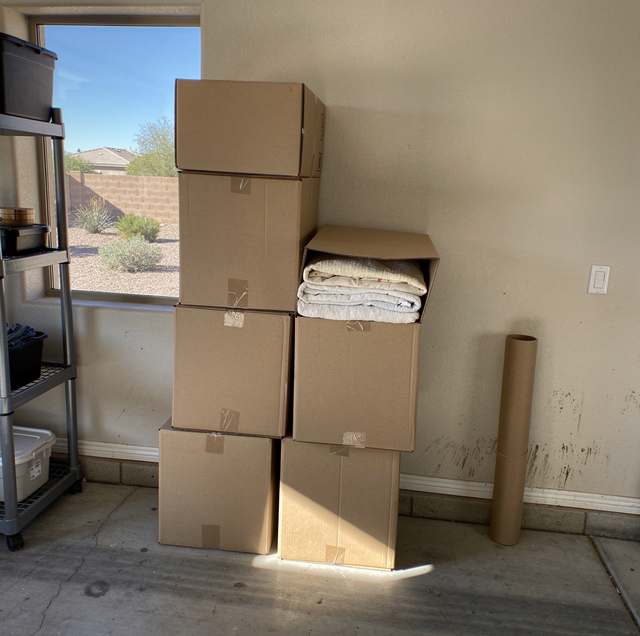
Under the lifted flap of a taped moving box against the garage wall, the flashlight beam lands on one fold of packed linens: pale cotton, a few creases, nothing moving. Whether that fold holds a bed bug depends less on the box or the garage than on where those linens lived before the tape went on. A garage that nobody sleeps in is an unlikely place for bed bugs to settle on their own, but what gets packed and carried into it can bring some along.
Why a Garage Is a Poor Home for Bed Bugs
Bed bugs live close to where people sleep and sit. They feed on people, so they hide in the gaps nearest a sleeper (mattress seams, bed frames, headboards, couch cushions) and come out to feed from there. The hiding place and the meal have to stay within reach of each other.
A garage breaks that link. People pass through it carrying groceries or a toolbox, and they leave within minutes. Nobody lies still there for hours, so nothing in the room offers a reason to settle in. Shelving, bins, and a stack of boxes give plenty of gaps, but gaps alone do not start a colony.
Clutter does change the picture once bugs are present, because every box adds places an inspection has to look through. That is a reason to leave the stack alone, not a reason to suspect it.
Packed Boxes and the Folds Inside Them
With nobody sleeping nearby, a bug in a stored box had no meal to wander toward. The ordinary route in is with what was packed, tucked into the folds of whatever it was resting in at the time: a blanket, a seam of a stuffed toy, the pleat of a curtain, the hem of a jacket. The lid closed over it, and the box went to the garage with it.
From there, it can stay tucked in the fold. How long a bug can wait varies widely, from days to many months, and a closed box offers no way to tell where in that range any one bug sits. A box that has been shut for a season has not shown anything yet, in either direction.
That is why a stored box is neither cleared nor condemned by sitting in a garage. The question is what went into it and where that item had been.
Where the Contents Lived Before the Tape Went On
The contents' history carries more weight than the box's location. Three groups cover almost everything in a garage.
Never near a bed: Paint, tools, garden gear, a box of dishes from the kitchen cupboard. Nothing here sat where bugs settle, so a bug had little chance of ending up inside.
Spent time in a bedroom or beside a couch: Linens, pillows, throw blankets, stuffed toys, clothes from a closet by the bed, decor that sat on a living room shelf. These came from the area where bed bugs hide, so any of them could have carried a bug into its box.
Packed while a problem was already in the house: This group depends on timing. A box taped up before the first bite or the first spot showed up was packed before anyone had seen a sign, which is not the same as a clear house: bugs can be present for a while before the first sign appears. A box packed in the weeks when something was already going on in the room it came from belongs with the second group, whatever the label says.
What to Do With a Box That Shows Signs
A flap lifted in passing can show dark spotting, rusty stains, or pale-yellow shed skins on the cardboard or the fabric inside. Those are signs worth taking seriously, and the right response is to stop looking.
Leave the box where it stands, do not empty it onto a table, and do not throw it out: a discarded box takes the evidence with it. Nothing needs doing until John has inspected, and that includes sorting the stack, repacking it, or sealing items in plastic as a fix.
The rest of the boxes stay shut as well. One box with signs says something about the items inside. It does not say what the neighbors hold.
If a box with signs sits against the door into the house, leave it there and keep that door shut until the inspection, using another way in, where there is one, for groceries and tools.
When the Garage Belongs in the Inspection
The inspection starts in the room of concern and in the places where people sleep and sit. The garage joins the search when the facts point there: boxes that came out of a room where bugs were found, boxes packed while a problem was already present, a bug or spotting found in the garage itself, or stacks heaped against the door that leads into the house.
Nothing about that has to be settled before the call. Tell John what is stored, roughly where each group came from, and when it was packed, and say plainly if a box shows signs. The inspection is free, and it ends one of three ways: bed bugs, another pest, or nothing found. If the garage gets a look and nothing turns up, the stack can go back to being storage.
The most useful thing to bring to that visit is a stack that looks exactly as it did the day the worry started. Boxes are easy to open and impossible to unopen, and every change to the pile makes the history harder to read.
Stored boxes tell more about the house they were packed in than about the garage where they sit. Leave them as they are, let the inspection read them, and the worry gets an answer based on what is found.
Frequently Asked Questions
The bin gives a bug little to hold, but the soft items inside are another matter. Tree skirts, stockings, felt ornaments, and ribbon-wrapped wreaths are fabric, and fabric has folds and stitching a bug can tuck into. Keep a bin like any other stored box: closed, in place, and on the list for John.
If it came out of the house, it carries the same seams and frame joints it had in use, and a piece that stood beside a bed or in a living room spent its time where bugs rest. Leave it standing as it is and mention it on the call, along with the room it came from.
Please do not. The order of a stack records when each box went in, with the oldest at the bottom and the newest on top, and that order helps show which boxes were packed during a problem. Moving them erases that record. Read what can be read from where you stand.
No. Dust and cobwebs show how long a box has sat undisturbed, and say nothing about what was inside on the day it was taped shut. A thick gray layer on a box packed from a bedroom in a bad month tells you only that it has been there a while.
Then the reasoning about an empty garage no longer holds. A cot, a spare bed, a sofa, or a recliner in the garage makes part of it a place where people sleep and sit, and it is judged like any other room in the home. Say so on the call so John knows to look there.
Ask John at the inspection. Treatment covers the whole home, and he is the one to say what that means for a garage full of storage. Nothing in the stack needs to move before the inspection to settle that question.
Note on paper the room each stored box came from — that list, with the boxes left in place, lets the free inspection settle whether the garage needs a look. Bed Bugs Arizona serves Phoenix and towns across Arizona. Call 623-451-0541.