

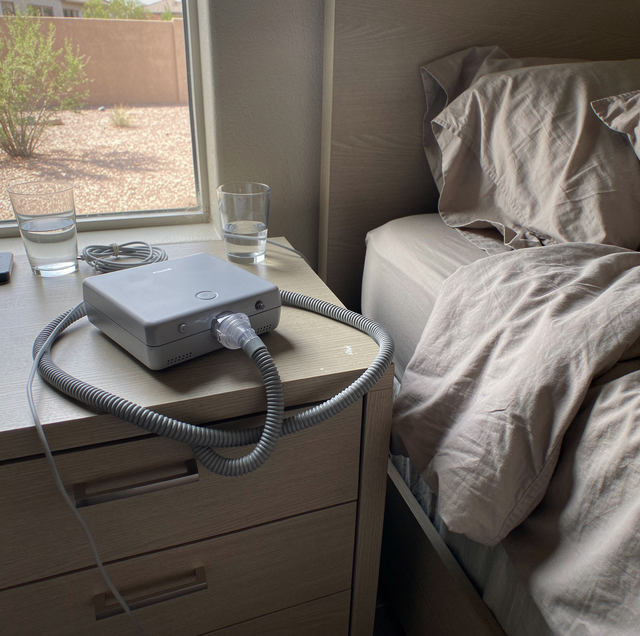
The tubing lies in loose loops across the nightstand, one end still pushed onto the machine and the other running up to the mask, which hangs from the bedside lamp by its headgear straps. Every morning the coil lands the same way, touching the lamp base, the edge of the mattress, and the back of the table where the cords drop to the outlet. Once signs of bed bugs have turned up in the bedroom, that coil starts to look different. Can bed bugs get into a CPAP machine? They can shelter on and around one, and in a heavy infestation they can work their way inside. None of that calls for opening the machine, spraying it, or setting the therapy aside. It calls for leaving the setup where it is and making sure John knows about it at the inspection.
Where a Breathing Machine Sits Relative to the Bed
Between meals, bed bugs rest in narrow, shaded gaps a short crawl from a sleeping person, come out to feed, then go back to the nearest one. The bed is where they settle first, and the objects within reach of the pillow come next.
A CPAP machine sits about as close to the pillow as any object in the room can. The machine stays on the nightstand or on a low shelf beside the headboard, the hose spans the gap to the bed, and the mask rests against the sleeper's face. In the morning, the mask and hose come off the bed and go back onto the table, the lamp, or a hook. Every night that gear crosses the same short distance between the mattress and the furniture beside it.
That nightly crossing is why the machine belongs in the conversation. Being near the problem, though, says nothing about where the problem started.
The Parts With Seams, Covers and Gaps
Every part of the setup that has a fold, a seam, or a joint is a place where a small, flat insect could tuck in. Going from the bed outward:
The mask: The soft cushion that seals against the face is set into a rigid frame, and the line where the two meet is a narrow groove. The headgear is fabric, stitched along its edges, with tabs that fold back on themselves to fasten. Those stitched edges and folded tabs could hold a bug just like a pillowcase hem could.
The hose: The tube connects at each end through a rigid cuff that pushes onto a port. The joint between the cuff and the port at either end is a fitted gap a bug could sit in.
The machine: The case is made of sections that clip or screw together, and each joint between two sections is a seam. A filter door, set on the back or side of some machines to cover the air intake, leaves a small gap around its edge. Where the machine has a water chamber for humidifying the air, the chamber slides into a dock, and the edges of that dock are another joint.
The cords and the bag: A power cord and, on some models, a separate power supply box run behind the nightstand to the wall, and a bundle of cords gathered behind furniture is shaded and seldom moved. The carry bag, with its zippered pockets and padded panels, has seams like any piece of luggage.
Each of these places is only a possibility. Only a look by someone who knows the signs settles which of them, if any, holds anything.
Inside the Case Versus Around It
A bed bug that reaches the inside of the machine finds nothing it needs there. There is no blood to feed on inside a case, so any bug sheltering in it still has to come out and cross the outside of the machine, the table, and the hose to reach the sleeper. The inside is a hiding place at most, never a place a bug can live off.
Bugs inside electronics are a heavy infestation finding, at a stage when the bed, headboard, and surrounding furniture can already hold many. In a light or early problem, the bed is the first place to look.
Around the machine, the picture is different. The underside of the machine where it rests on the table, the space between the machine and the wall, the cord bundle, the folds of the headgear, and the bag are all outside the case, all shaded, and all within a short crawl of the mattress. If bugs are using the setup at all, those outer spots are where spotting, pale shed skins and, in tight seams, tiny eggs could show.
None of those signs are something to hunt for by taking the gear apart. Pulling the cushion from its frame, unclipping the case, or lifting the machine off the table to check underneath can knock bugs loose onto the floor or the bed, away from where they were resting.
Keeping the Therapy Going Until the Inspection
The machine is there for health reasons, and bed bugs do not change that. Whether to use the machine and how remain questions for the health care provider who prescribed it. A possible bed bug problem does not call for unplugging the machine or carrying it to another room.
Keep the routine care the same as well. Whatever the maker's instructions already say about the mask, the hose, and the water chamber stays as it is, and nothing gets added: no store spray, no bug bomb, no rubbing alcohol, no wipe from the cabinet under the sink. A spray that wets one bug misses the rest.
Leave the case closed and the filter door in place, and keep every spray away from the air intake, where it would enter the air path. Any opening, repair, or internal service belongs to the equipment supplier or the maker's service center.
What helps before the inspection is a phone call. A clear close-up photo of anything suspicious near the machine can be texted ahead, and then the setup stays where it is until John has looked.
Telling John About the Machine and Its Gear
A breathing machine at the bedside is worth raising at the start of the inspection, before anyone starts looking, so the plan for the home is built with it in mind.
Points worth covering:
- Where the machine sits, and whether it has ever moved between rooms.
- Where the spare masks, cushions, filters and hoses are kept.
- Whether the machine runs from a cord to the wall, a separate power box or both.
- Anything that has been noticed on or near the gear, and when.
The machine counts as one of the electronics in the home, and electronics, when they are part of a job, are treated with products that do not harm them. Past that, how the machine and its gear fit into the work, and whether anything should be put away first, is for John to settle at the inspection when he goes over the prep. The treatment covers the whole home, with a second visit two weeks later, so the bedside table is one stop among every room.
Equipment that sits beside the bed every night is bound to come up once bed bugs do, and the coil on the nightstand gives the worry an easy place to land. The answer for it matches the answer for the bed: leave it where it is, keep the nights as they were, and let the person doing the inspection see the whole setup before anyone decides what it needs.
Frequently Asked Questions
It adds some. A bare hose is plastic, and the spiral ribbing on its outside is open to the air. A fabric or foam wrap pulled over it adds a seam running the full length of the tube, a hook-and-loop or zipper closure along that seam, and a gathered cuff at each end.
It can. A carry bag that sat on the floor of a hotel room, or beside the bed in someone else's guest room, had the same exposure as a suitcase on that trip. Mention any overnight stays in the weeks before the signs turned up, since the timing helps make sense of what the inspection finds.
No. The machine's sensors read air pressure and flow for the therapy, and nothing in those readings can register an insect. A machine running normally with no warnings says nothing either way about bed bugs, so the signs around the gear are what count.
It adds one more joint. A heated hose carries a thin wire inside its wall and ends in a bulkier cuff with an electrical connector where it meets the machine. That connector plugs into a fitted socket, the kind of tight joint a bug could sit beside.
They could. Straps that rest against skin every night pick up skin oil and makeup, and that wear darkens the fabric in a soft, even band along the line where the strap touches the face. Leave the headgear as it is so the inspection sees the marks in place.
It is one more gap within reach of the bed. Some nightstands have a round cutout or a plastic grommet in the back panel so cords can pass through to the outlet, and the ring where the grommet or the cut edge meets the panel is a thin, shaded seam. Leave the cords threaded as they are and point the hole out to John.
Raise the CPAP machine when you set up a free inspection — John can plan the whole-home treatment with the machine and its gear in mind. Bed Bugs Arizona serves Phoenix and towns across Arizona. Call 623-451-0541.